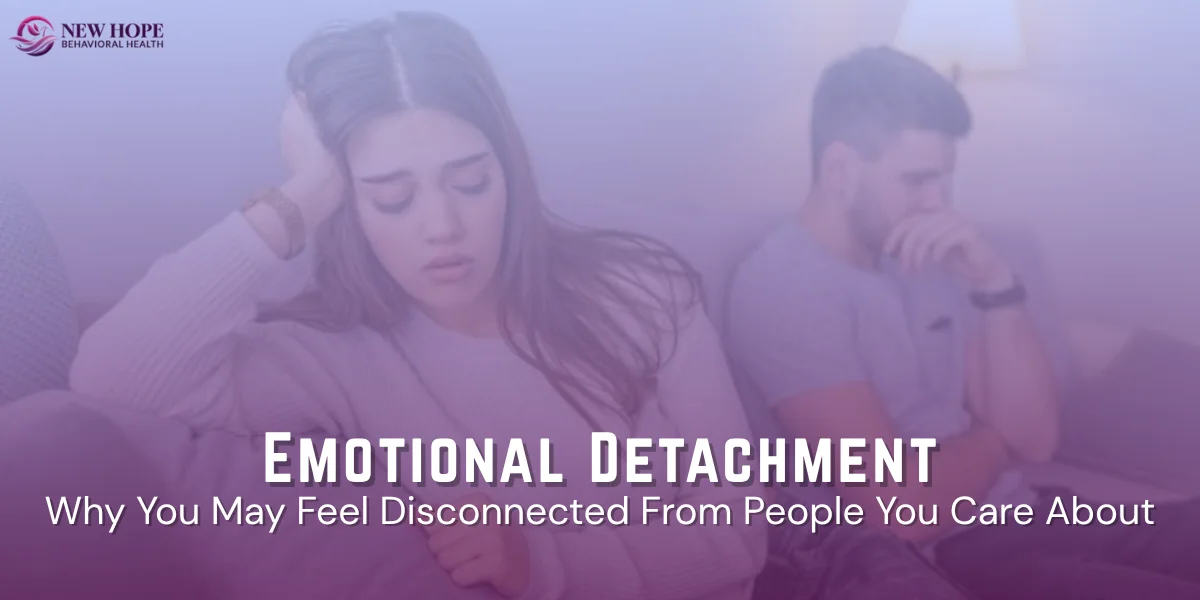
Feeling close to the people you love does not always come naturally, even when you care deeply about them. Emotional Detachment can create a strange distance between your inner world and the relationships that matter most. You may still value your family, partner, or friends while feeling unable to access the warmth, concern, or emotional presence you once had. Emotional Detachment is not necessarily a sign that you have stopped caring. It can be connected to prolonged stress, depression, anxiety, trauma, burnout, or other experiences that leave the mind emotionally guarded.
For some people, Emotional Detachment develops gradually. Conversations become harder to engage in, affection may feel muted, and important moments can pass without producing much emotional response. Emotional Detachment can also be confusing because the person may recognize intellectually that they care while feeling little emotional connection inside.
So what is happening beneath that distance, and when should you seek professional support? Understanding the causes can be an important first step toward responding to the experience with compassion rather than self-judgment.
What Is Emotional Detachment?
Emotional Detachment refers to a reduced sense of emotional connection to other people, situations, or even your own feelings. It can involve feeling numb, distant, unusually indifferent, or unable to respond emotionally in ways that once felt natural.
It is important to distinguish emotional distance from simply needing personal space. Everyone has periods when they want quiet, privacy, or time alone. A more persistent pattern becomes concerning when it causes distress, interferes with relationships, or makes everyday life feel emotionally flat.
Emotional connection is not a switch that is either completely on or completely off. It can fluctuate according to stress, sleep, physical health, life circumstances, and psychological well-being.

Why Do You Feel Disconnected From People You Care About?
There is rarely one universal explanation. Emotional distance can develop for different reasons, and several factors may overlap.
Chronic Stress and Emotional Exhaustion
When the mind remains under pressure for an extended period, emotional resources can become depleted. Work demands, family responsibilities, financial concerns, relationship difficulties, or ongoing uncertainty may leave little psychological energy for connection.
A person may begin functioning on autopilot. Responsibilities still get handled, conversations still happen, and daily routines continue, but emotional involvement becomes harder.
Depression and Emotional Numbness
Depression does not always appear as obvious sadness. Some people primarily experience reduced interest, low motivation, emptiness, or difficulty experiencing pleasure.
Emotional Detachment may accompany this broader loss of emotional responsiveness. Relationships can feel less rewarding, and a person may withdraw because interacting requires more energy than they currently have.
This is one reason persistent emotional distance deserves attention rather than being dismissed as simply becoming less social.
Anxiety and Constant Mental Pressure
An anxious mind can become heavily occupied with worry, anticipation, self-monitoring, and perceived threats. When attention is consumed by internal concerns, being emotionally present with another person can become difficult.
Someone may listen to a conversation while simultaneously worrying about what could go wrong. Over time, that internal pressure can create a sense of distance from relationships.
Trauma and Protective Responses
Traumatic experiences can affect how a person responds to emotions, closeness, trust, and perceived safety. For some individuals, emotional distance may become a protective response that developed during overwhelming circumstances.
In this context, Emotional Detachment does not necessarily mean the person lacks affection or empathy. Emotional withdrawal may instead reflect an attempt to avoid becoming overwhelmed.
Trauma responses are complex, however, and emotional distance alone cannot establish that trauma is responsible.
Burnout and Prolonged Overload
Burnout can affect more than professional motivation. Extended psychological and physical demands can leave someone feeling depleted across several areas of life.
When the mind is continually operating in survival or task-management mode, emotional availability may decline. Even relationships that were previously comforting can begin to feel like additional demands.
What Does Emotional Detachment Feel Like?
The experience varies considerably from person to person. Some people notice a general sense of numbness, while others recognize the problem primarily through changes in their relationships.
You might notice:
- Difficulty expressing affection or warmth
- Reduced interest in conversations
- Feeling distant even when physically present
- Trouble identifying what you are feeling
- A tendency to withdraw during emotionally intense situations
- Less excitement about activities or relationships
- Difficulty responding when someone shares strong emotions
- Feeling as though you are observing your life rather than fully participating in it
- Increased preference for isolation
- Guilt or confusion about feeling emotionally distant
These experiences do not automatically indicate a mental health disorder. Context, duration, intensity, and impact on functioning all matter.
Is Emotional Detachment the Same as Not Caring?
Not necessarily.
One of the most painful parts of Emotional Detachment can be the confusion between feeling disconnected and actually losing affection. A person may think, “Why don’t I feel what I think I should feel?”
Emotions do not always reflect intentions in a straightforward way. Someone can care about a relationship while simultaneously struggling with emotional availability.
This distinction matters because judging yourself harshly may add another layer of distress. Instead of immediately concluding that your relationships no longer matter, it may be more useful to consider whether stress, mood changes, unresolved experiences, or emotional exhaustion are affecting your ability to connect.
How Emotional Detachment Can Affect Relationships
Relationships generally require some degree of emotional presence. When that presence becomes difficult, misunderstandings can develop.
A partner may interpret withdrawal as rejection. A family member may believe you are angry or uninterested. Friends may stop reaching out if conversations repeatedly feel one-sided or distant.
Meanwhile, the person experiencing the disconnection may feel guilty but not know how to change it.
This creates a difficult cycle: distance can produce misunderstanding, misunderstanding can create additional stress, and additional stress can make emotional connection even harder.
Recognizing this cycle does not mean blaming either person. It simply highlights why communication and professional support can sometimes be useful.
When Should You Seek Professional Help?
Temporary emotional distance can happen during demanding periods. However, professional support may be appropriate when the experience persists, becomes more intense, or begins affecting important areas of life.
Consider speaking with a qualified mental health professional if you have ongoing difficulty connecting with people, feel emotionally numb most of the time, have withdrawn significantly from relationships, or notice major changes in your mood or functioning.
Emotional Detachment may also deserve closer attention when it occurs alongside depression, anxiety, trauma-related symptoms, severe stress, sleep problems, substance use, or thoughts of self-harm.
A mental health professional can look beyond the symptom itself and consider the broader picture. That may include your emotional history, current stressors, relationships, physical health, medications, sleep, and other psychological symptoms.
How Is Emotional Detachment Evaluated?
There is no single test that can determine why someone feels emotionally disconnected.
A clinician typically begins by listening carefully to what has changed and when the change began. Questions may focus on mood, anxiety, trauma, relationships, daily functioning, sleep, stress, substance use, and other relevant areas.
The goal is not to attach a label to every difficult feeling. Rather, assessment helps identify patterns and determine whether another mental health or medical concern may be contributing.
A careful evaluation is especially important because emotional numbness can occur in several different circumstances. Treating the wrong underlying issue can make progress more difficult.
Treatment and Support for Emotional Disconnection
Treatment depends on what is contributing to the emotional distance. There is no universal approach, and a thoughtful care plan should reflect the individual’s symptoms, circumstances, preferences, and goals.
Psychotherapy
Therapy can provide a structured setting for understanding emotional patterns and exploring what may be making connection difficult.
Depending on the individual’s needs, a mental health professional may use evidence-based approaches such as cognitive behavioral therapy, supportive therapy, trauma-informed interventions, or other clinically appropriate methods.
The objective is not to force emotions to appear. Instead, therapy can help a person understand internal experiences, develop healthier coping strategies, improve communication, and gradually become more comfortable with emotional awareness.
Addressing Underlying Conditions
When emotional disconnection occurs alongside depression, anxiety, trauma-related symptoms, or another mental health condition, treatment may focus on the broader concern.
Addressing the underlying problem can sometimes improve emotional availability as overall psychological functioning becomes more stable.
Medication Management
Medication may be considered when clinically appropriate for an underlying or co-occurring mental health condition. Medication decisions should be based on an individual assessment by a qualified healthcare professional.
Medication is not a universal solution for emotional distance. The appropriate treatment depends on the person’s symptoms, history, diagnosis when applicable, and overall needs.
Can You Reconnect With People Again?
Recovery does not necessarily mean becoming emotionally expressive all the time. Healthy emotional functioning includes a range of experiences, including the ability to connect, set boundaries, tolerate difficult feelings, and spend time alone without feeling completely cut off.
For someone experiencing Emotional Detachment, progress may involve becoming more aware of emotions, understanding personal triggers, communicating needs more clearly, and gradually rebuilding trust and emotional presence.
It can take time. If emotional distance developed as a response to prolonged stress or difficult experiences, expecting an immediate transformation may create unnecessary pressure.
Small changes in awareness can matter. Noticing that you are withdrawing, identifying what you are feeling, and discussing those changes with a professional can create a more informed path forward.
Why Professional Assessment Matters
It can be tempting to search for a quick explanation online and decide that one condition must be responsible. Mental health symptoms rarely fit into such neat boxes.
Emotional Detachment can have different causes, and the same outward experience can mean different things for different people. A qualified clinician can consider the full context rather than focusing on one symptom in isolation.
New Hope Behavioral Health emphasizes comprehensive assessment, personalized care plans, medication management, and holistic support as part of its behavioral healthcare services. The practice provides outpatient psychiatric care as well as in-person and telepsychiatry services in Abilene, Texas.
Its stated approach emphasizes empathy, respect, confidentiality, and individualized care for adults, adolescents, children, seniors, couples, and families.
When Emotional Distance Starts Affecting Your Life
You do not have to wait until a relationship reaches a breaking point before asking for help.
Emotional Detachment can be subtle at first, but persistent disconnection may affect intimacy, communication, family relationships, friendships, work, and general quality of life. Paying attention to the pattern early can make it easier to understand what is happening.
If you are in Abilene and want to discuss ongoing emotional or behavioral health concerns, New Hope Behavioral Health offers appointments with mental health professionals and provides personalized outpatient care. The practice lists its office at 1500 Industrial Blvd, Suite 202, Abilene, Texas, with weekday hours and appointment scheduling through its website.
The important question is not simply, “Why can’t I feel connected?”
It may be more useful to ask, “What has made connection difficult for me lately, and what kind of support could help?”
That shift can turn self-criticism into curiosity, which is often a much more productive place to begin.